
Player Valuation: How is it actually done?
As an article by The Athletic puts it:
“So many factors come into consideration when calculating a player’s value: talent, age, potential, position, contractual situation, salary, injury record, technical performance data, international experience, image, the financial strength of the selling club, the level of their current league — the list goes on and on.”
Let’s take a quick dive into some of the factors provided and briefly dissect them:
Talent
The Oxford learners dictionary defines talent as a natural ability to do something well. By virtue of an individual being a professional football player, they have displayed an ability to play football well above their peers. Quantifying talent is very difficult unless we start including some stats (i.e., passing accuracy, key passes, interceptions etc.). It remains a challenging metric to measure given it may be based on form and match performances. A mitigating factor is long term scouting done by clubs to track a player’s performance (talent).
Verdict – Subjective.
Age
Economics. For most assets, the newer the item, the more value is placed on it. In the football space – the younger the player’s age, the more value is placed on them. A player’s potential/value/contribution for the years to come is discounted to the present. A certain Net Present Value method may be adopted, which can assist in trying to make the process more objective.
Verdict – partially Objective.
Potential
The definition from Oxford languages states potential as having or showing the capacity to develop into something in the future. Depending on a player’s position on the field and their ability to play multiple roles on the pitch [versatility] (RM, RB, RWB, LM), this will have an effect of raising their value. Examples of versatile players includes David Alaba (Real Madrid), Lionel Messi (PSG), Sergio Ramos (PSG), Bernardo Silva (Man City), Angel Di Maria (Juventus), Joshua Kimmich (Bayern), Cesar Azpilicueta (Chelsea) and Kevin De Bruyne (Man City) just to mention a few – https://www.squawka.com/en/world-class-versatile-footballers-multiple-positions/. Measuring potential is quite challenging since past data and performance may not consider future factors that may or may not derail a player’s career (i.e., Injuries, formation played).
Verdict – Subjective.
Position
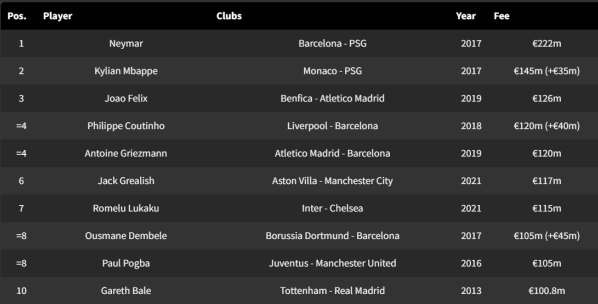
The further up the field, the more value one is bound to have placed. The more contribution towards offense/ attacking play (Goals, Assists, Key Passes in the final 3rd etc), the more value one tends to earn – an evident example are the top 10 Transfers of all time, that show the trend favouring Midfield and Attacking players more than Defensive players.
Lest we forget the famous words — “Attack wins you games, defence wins you titles.” A famous quote from arguably the greatest manager of all time, Sir Alex Ferguson – Attack wins you games, defence wins you titles- Gameweek 1 | Draft Fantasy Blog
Verdict – Subjective.
Contractual situation
The more the years on the contract, the more value a player will command – because of the potential cashflows from sponsorship deals and contribution on the pitch to be realised. The less the duration left on a contract, the less value attached to a player. The Net present value concept may apply here.
Verdict – partially Objective.
Injury record
This factor has slightly similar mechanics as the age factor. The more injury prone a player is, the less likely of a contribution on the pitch, which in most cases equates to a lower valuation placed on them. Ousmane Dembele’s (FC Barcelona) value has fluctuated over the years due to his participation (or rather lack of participation) on the pitch – https://www.transfermarkt.com/ousmane-dembele/marktwertverlauf/spieler/288230.
Verdict – partially Objective.
Technical performance data
It bases on information provided by the medical and technical team over a player’s contribution on the pitch be it in training or in-game – hence you see players wearing the black GPS vests on top of their shirts. These GPS devices are able to capture over 1250 data points per second to measure how much and how hard the players are working, and players and coaches are able to analyse data such as total distance, top speed, number of sprints, sprint distance, power, load, intensity, and more- https://www.transfermarkt.com/ousmane-dembele/marktwertverlauf/spieler/288230.
Verdict – partially Objective.
Image Rights
The concept of image rights has been become pivotal in a footballer’s career. Image rights are in a football context, image rights are, simply put, the player’s likeness – that is, his image, his name, his nickname, his voice, his signature, and all other characteristics unique to the player. Iconic stars such as Lionel Messi and Christiano Ronaldo’s image rights alone carry a very significant portion of their valuation, due to the potential of associating any products with their name. A price can be put on the factor which helps in determining a player’s value – https://www.goal.com/en-au/news/what-are-image-rights-in-football–how-did-they-affect-dybalas-transfer-to-tottenham/1drdzc2ljhxhyz7goamk1q01l
Verdict – potentially Objective.
Financial strength of the selling club
For clubs that play in the lower-tier league, they are more likely than not, have a low valuation as a club and as such, their players will most likely follow suit in terms of their value. For clubs with a high valuation and based in a highly ranked, they are less likely to sell due to their financial hold. PSG and Real Madrid rarely sell and only let of a player usually through contract expiry – https://www.pulse.ng/sports/football/top-10-richest-football-clubs-in-the-world-from-barca-to-psg-to-man-utd/fm33pyv
Verdict – Subjective.
Outlier Aspects
Player Demand
“On top of that, the amount of interest in a player can be a game-changer in terms of the fee. Keith Wyness, the former Everton chief executive, tells The Athletic. Unless you’ve got an auction, you can’t really drive up the price, so that’s an important factor”. The World Cup 2022 in Qatar has given Players such Sofyan Amrabat, (Morocco Midfielder) on the spotlight, and Fiorentina, may face a challenging prospect of keeping him if suitors come in the January 2023 transfer window. – https://www.si.com/soccer/2022/12/12/world-cup-players-stock-rise-transfer-window
Verdict – Subjective.
Timing
The closer we are to deadline day, the more the value of a player goes up. This is simply because the selling club will need to find a replacement as well and time factor plays a role. If everyone knows Club XYZ received $50m dollars from Club P for the sale of player X, then It means when Club XYZ looks to replace, the seller clubs will charge upwards of 40-45m as they know club X can afford it. Arsenal buying Aubameyang put Borussia Dortmund in a tough space – https://www.transfermarkt.com/most-expensive-deadline-day-transfers/index/galerie/357?page=8. Borussia Dortmund in this case was our Club XYZ, although a loan deal ended up being done – https://bleacherreport.com/articles/2764137-chelsea-transfer-news-michy-batshuayi-fee-rumoured-as-dortmund-hunt-summer-deal
Conclusion
The majority of factors considered for player valuation by the surface seem to be subjective, but with a lot of data driven metrics now being used in player performances, we hope to see more objective and realistic player valuation – plus adding inflation too!
Tapiwa Z. Chiri, CA(Z) is an avid football fan and supports Paris St Germain based in the French First Division (Ligue 1). Tapiwa writes these articles in his personal capacity.
 The Analyst’s Arena
Leave a comment